Monday, November 18, 2019


                       PUNJABI TRADITIONAL WEAR

Patiala Salwar Suits

Punjabi Salwar Suit is a traditional garment worn by women in the Punjab region of India, after which it is named. These popular Punjabi dresses are also called salwar kameez and are amongst the most commonly worn Indian clothes for women of all ages. Origins of this dress can be traced to the Mughal era, when the invading Mughals introduced them to the Indian public; over the years, the design evolved into its present day form. 
Today it is a beloved fashion garment across the Indian subcontinent, perhaps due to its inherent comfort and versatility.


Traditional Punjabi salwar kameez consist of three distinct pieces. The kameez, or kurta, is the top piece, generally long-sleeved and knee-length with side seams that are cut to be open below the navel. The salwar or patiala is a loose, comfortable set of pants with a wide and ballooning shape at the top which tapers down at the bottom.


A distinctive feature of the salwar is the pleating at the waist and the use of the drawstring which can be adjusted to fit as per personalized levels of comfort. Usually this combination is incomplete without a long scarf called the dupatta or odhani, worn folded over the shoulders. It can also be worn around the neck or over the head, as per individual tastes.

CUSTOMS OF MENS IN PUNJAB
The customary costume for men in Punjab is Kurta Pyjama. You can find so many men wearing this clothing. The Kurta is a type of shirt which is straight-cut and long. The Pyjama is also loose which need to be tied on the waist. There are few men who also like to wear Kurta with a Tehmat or Lungi which is a type of sarong. Colorful Pagri or Pugg (Turban) is a religious for Sikh in Punjab. Men wear different colors of Turban as per their clothing.

Traditional Dresses of East India


INTRODUCTION TO EAST INDIA East India (also known as Eastern India) is a region of India consisting of the Indian states of West Bengal, Bihar, Jharkhand ,Odisha and also the union territory Andaman and Nicobar Islands. West Bengal's capital Kolkata is the largest city of this region. The states of Odisha and West Bengal share some cultural and linguistic characteristics with Bangladesh and with the state of Assam. ODIAS the only classical Language..
3. ABOUT MANIPUR Manipur is one of the pretty states of India which is located in the remote north eastern part of the country. The state is blessed with natural beauty and has unique culture, tradition and heritage. Though there’s not much inflow of tourism in the state, every year the land observes tourism festival, known as “Sangai Festival” for 10 days with great enthusiasm in the month of November to promote tourism in the state. People of Manipur are very religious and friendly, they welcome guests with heartfelt hospitality.


Costumes of East Indian States, Indian CostumeSaree is a common dress for women in eastern states of India. Salwar Kameez is also popular among females in Bengal. In Bihar, most of the people wear traditional clothing. Men consider Dhoti and Kurta and women go for Sarees. There is another type of Dhoti known as Lungi popular among men in this state.


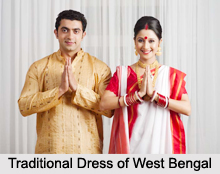
Traditional Dress of West Bengal
Costumes of West Bengal show the cosmopolitan culture of the state. Saree is the traditional dress of women in West Bengal. In West Bengal, sarees are primarily woven in cotton and silk. The traditional weavers of West Bengal are reputed all over because of the quality of fabric spun and their fine thread work. Different varieties of sarees are woven in the various districts of West Bengal. Bengal silk is famous for its sophisticated quality and texture. The only difference is in the way of wearing it. The Bengali style of wearing a saree has no pleats and is elegantly draped around the body and the pallu has a bunch of keys that falls over the shoulder. Baluchari, Jamdani are famous traditional sarees of West Bengal. Traditional dress for men in West Bengal is the Punjabi and the Dhoti.


Traditional Dress of Orissa
Women in Odisha wear the Oriya Saree, which is often draped with a 5 yard cotton ikat cloth. Traditionally, the women of Odisha dress in sarees of blue, red and magenta and other deep colours, with ikat patterning. Odisha is recognized for its handlooms, especially the Odisha sarees. In Odisha, there are many different motifs and designs woven in cotton and silk to create the distinctive sarees of Odisha like Bomkai, Sambalpuri which are also famous in the international markets.


       SOUTH INDIAN TRADITIONAL 


In Southern region of South India consists of Tamil Nadu, Karnataka, Andhra Pradesh, Kerala and Pondicherry. South India established early trade contacts with the outside world. It was renowned for its fine cotton production centres and intricate patterns dyed in madder and indigo, which were in great demand in Saudi Arabia, SouEastAsia, the Far East, Java, Sumatra and the Malay Peninsula.The artisanal skills of this region were highly appreciated – colourful printed cottons, Zari and silk – woven saris, and silk dyed, ikat – woven fabric.


From 14th century onwards, same traders with trade links with Southern India developed their colonies at Calicut, Pondicherry and Madras.The Southern India people had close interaction with the foreign traders and produced work according to the demands of the market. But personally preferred their own traditional garments, mainly unstitched drape. Loose drape customer were more appropriate for the people of this region climatically as well. Therefore, the textiles and customer of this region were not too influenced by the outside world. Traditionally the dhoti, Kurta, Shirt, angavastram and turban form the ordinary dress for men in southern India.
                                                                     (copied from Internet)

The ghagra, choli, blouse and odhani comprise the traditional dress for women. Women of this region prefer the sari, so there exist a rich tradition of cotton, silks and Zari – Woven saris. There are various tribal people also, who wear bright and more colourful costumer.The Sangam literature and the epics of south india, silappadikaram and manimekalai (1st century BC – 3rd century AD), inform that cotton – and silk weaving traditions existed during this period.

Sari: The term ‘Sari’ originates from the Sanskrit words shati and shatika, which appears for the first time in the panchatantra.
                                                                     (copied from Internet)
                                                     

Women in the Vedic period wore an antariya (lower garment), an uttariya (upper garment) and a kaya band (waistband). Gradually, from the Sunga and Kushan periods, we have descriptions of a garment that is like a Sari.
From early references, it appears that initially the sari was the only garment worn by woman of southern india. With time, however, a choli (upper garment) was added to this attire. A petticoat (long skirt) was further added to this ensemble, making it the three piece attire that it is in this modern days.

Dothi

The mundu is a garment worn around the waist in the Indian states of Kerala, the Tulu Nadu region of Karnataka, and the Indian Ocean island nation of Maldives. It is closely related to the dhotisarong, and lungi. In South Kanara, a district of Karnataka state, the Tulu speaking folk and Beary community also wear the mundu. It is normally woven in cotton and coloured white or cream. The colour is dependent on whether the cotton is bleached or unbleached. A khaddar mundu is made using handlooms. When unbleached, the mundu is called "neriyathu". In modern times, two types of mundu are prevalent—the single and the double. A single mundu is draped once around the waist, while the double is folded in half before draping. A mundu is usually starched before us


                                                             (copied from Internet)
  

salwar 

It comprises a pair of trousers known as the salwar and a tunic called the kameez. Traditionally, the salwar trousers are tailored to be long and loose-fitting with narrow hems above the ankles that are stitched to look like cuffs.
                                                            (copied from Internet)


INDIAN ETHNIC WEAR


Indian culture is followed with their rituals with the simplest way. Indian culture covered all the rituals of all cast-people whose live in India and that's a real Indian culture. "Ethnic wear is the part of Indian culture that truly followed by the people". Indian culture is followed by the Indian people and also followed by the USA-people. Indian culture teaches us to respect the people and behaving well. Indian is said hello to another people with "Namaste" according to their good manner because Indians never underestimate to people.

                                                         (Courtesy- Copied from Internet)


India accepts all people and never hurt too many- people and that's the real culture of India. The population of India is high as compared to USA population. Indian newspaper it comes out in many different languages like Marathi, Panjabi, Gujarati, English, Hindi and much more that are read by uncountable people. One more important thing is that many English words come from Indian Sanskrit languages. For example, bhatra become a brother, matra becomes mother, trikoniti become trigonometry, gaamiti becomes geometry. Indian ethnic wear is that part of the Indian culture. Indians are wearing ethnic outfits like ghagra-choli, dhoti-kurta, salwar-suit, kurta-pajama, saree in wedding and some special occasion. This ethnic wear followed by all age of people. Indian people decide clothes according to occasion otherwise its base on the relation like if the relation is like "dur ke ristedar"(hindi words) then they don’t extraordinary.

1.Indian Saree


sarisaree or shari is a women's garment from the Indian subcontinent that consists of a drape varying from 4.5 to 8 meters (5 to 9 yards) in length and 60 to 120 centimetres (2 to 4 feet) in breadth that is typically wrapped around the waist, with one end draped over the shoulder, baring the midriff.
Indian brides typically suits to wear Saree durng marriages. It may differ respect to states


                                                           Indian Brides 
                                                            (Courtesy- Copied from Internet)

Indian Brides


The best thing about Indian culture is its exquisiteness. North, East, South or West, various rituals and customs around the nation are deeply loved and respected. You would not believe, but it is true that with every state or region, the customs in India vary. Be it festivals, weddings, or any other religious events, everything has its own uniqueness and with it comes its distinctive colour, flavour, and taste. 


In India, weddings are not just an occasion to celebrate the union of two souls, but a bond that gets cemented for saat janam. Indian weddings are larger than life celebrations, which see brides flaunting their best looks. So, here are a few bridal looks from India that will leave you mesmerised.
The quintessential South Indian bride


For those of you who want to don the traditional South Indian bridal look but don't want to go overboard, then this bride’s look is all the inspo you need. Her choice of minimal south Indian wedding jewellery along with a classic yellow and orange kanjivaram saree make this bride look absolutely radiant.

Totally loving how both these south Indian brides are showing off their love for diamonds by replacing all the temple and gold jewellery for diamonds. The shiny kamarbandh and mathapatti along with the long necklace steal the show!